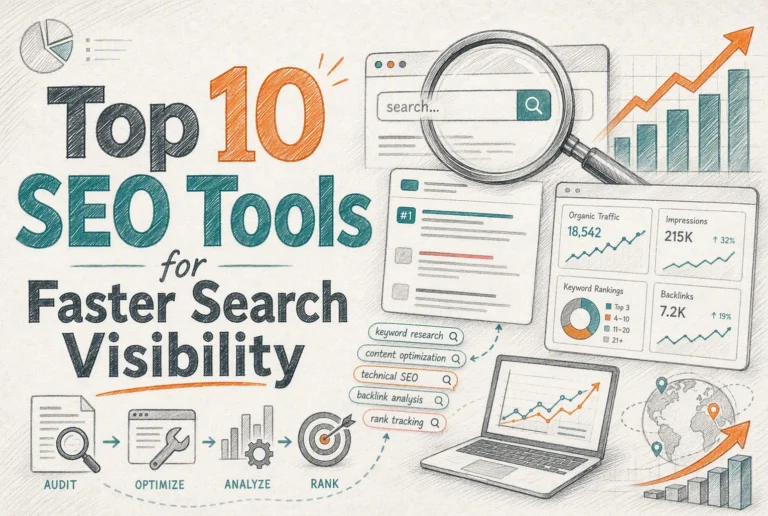
Quick Summary: Dedicated SEO tools provide faster rank tracking and quick insights, ideal for solo users or teams needing rapid updates. Full SEO software offers broader context and integrated workflows, helping teams act faster on insights but often slowing setup. The best choice depends on whether your priority is quick detection or comprehensive action within one platform.
If you need rank tracking speed, dedicated tools usually win. They show movement fast, so you can act before traffic drops. Full SEO suites can still make sense if you also need audits, research, and reports in one place. I’ve tested both setups across client workflows, and this comparison shows where rank tracking gets faster, where rank tracking slows down, and what fits your team.
SEO Tools vs SEO Software for Rank Tracking Speed
| SEO tools | SEO software | |
|---|---|---|
| Core purpose | Specialized rank tracking and narrow SEO tasks | All-in-one SEO workflow platform |
| Setup speed | Usually faster to launch | Slower, more configuration |
| Tracking depth | Strong for rankings and SERP features | Broad, with more context |
| Reporting speed | Fast, lightweight reports | Faster for combined dashboards |
| Best for | Solo users and teams needing quick ranking insight | Teams wanting one system for multiple SEO tasks |
How SEO tools and SEO software Compare
SEO tools
SEO tools are focused apps built to do one job fast, often rank tracking first. They fit solo users or lean teams that need quick ranking insight, light reports, and fast setup without much config.
Key strengths
- Fast to launch
- Strong rank and SERP tracking
- Lightweight reporting
SEO software
SEO software bundles rank tracking with audits, keyword research, competitor analysis, and reporting. It fits teams that want one system for the full workflow, even if setup takes longer and dashboards need more input.
Key strengths
- Broad search context
- Combined dashboards
- Better fit for multi-task SEO teams
Why Rank Tracking Speed Depends on Workflow, Not Just Features
Speed is really two things: how fast you spot a change, and how fast you act on it. A broad SEO suite may show more data, but that does not help if alerts, filters, and ownership are buried. Google says Search Console data can be preliminary and the latest numbers may still change in the next hours in its Performance report documentation.

Google Search Console is great for truth from Google. It shows clicks, impressions, and average position for your own site. But Google also explains that position is an average, not a live single ranking, and it reflects your topmost result across impressions in its position metric guide. It cannot replace competitor tracking or fast daily checks.
Faster rankings usually come from a tighter response loop, not a longer feature list.
Dedicated rank trackers feel faster because they remove extra steps:
- daily snapshots
- cleaner alerts
- keyword lists tied to action
- easier handoff to content or technical teams
Also Read: https://saasguru.info/best-ai-video-generator-lifetime-deals/
When SEO Software Wins on Rank Tracking
Full SEO software wins when your team needs rank tracking plus action in one place. Google says combining Search Console and Analytics gives a more complete view of how people find and use your site, which is why all-in-one platforms can speed decisions across reporting and fixes Google Search Central.
-
One dashboard for the whole SEO loop
-
You track positions, spot page drops, check CTR, review traffic, and assign fixes without jumping tools. That matters more for busy teams than raw ranking speed.
-
Where more context can create faster moves
-
SEO software helps when rankings are only one signal. If a keyword drops but conversions stay strong, you may leave it alone. If rankings hold but clicks fall, you rewrite titles first.
Better insight does not always mean faster rankings. It often means faster priorities.
- When complexity becomes the slowdown
- Bigger suites slow small teams if setup is heavy. Search Console data is still delayed and not live, so extra layers can add noise if you only need quick daily checks SEOTesting.
Also Read: https://saasguru.info/appsumo-sumo-day/
Which Should You Choose for Faster Rankings?
Choose SEO tools if you need fast, focused tracking. Google says Search Console helps you measure clicks, impressions, and average position fast in one place through its Performance report. That means quicker insight, not quicker fixes.

Choose SEO software if you need rank tracking plus content, audits, and fix workflows. Google also notes Search Console helps you spot issues and fix your site, which matches broader software better.
Final rule: pick the option that removes your slowest step. Insight bottleneck – choose tools. Execution bottleneck – choose software.
Pick the faster setup for your workflow, then save on SEO tools with verified lifetime deals at SaasGuru.
Frequently Asked Questions
Q1: Compare SEO tools for ranking faster?
Dedicated rank trackers surface movement faster. Broader SEO software helps you act faster by pairing tracking with audits, briefs, and fixes. If you need quick visibility, pick trackers. If your team wants fewer handoffs, pick full software.
Q2: Which is better for a small business?
Small teams usually win with simple rank trackers first. You get clear weekly data without paying for features you will not use. Move to broader software when content, tech fixes, and reporting start slowing execution.
Q3: Can SEO software improve rankings faster than tools?
Yes, if your bottleneck is doing the work, not spotting changes. Software can speed audits, issue checks, and content updates. If your bottleneck is measurement, a focused tool gives faster, cleaner signals.
Conclusion
Dedicated rank trackers surface movement faster. Broader SEO software helps you act faster. Since Google uses many signals and updates systems often, speed of insight and speed of execution are different bets.